
AndWeGo
Mobile Case Study, March 2023
The ease of travel has changed quite dramatically following the aftermath of the global pandemic. Our company would like to build a modern app to assist travelers in planning their next trip.

Overview
The Problem
Travelers are anxious they are making the "right choices" when planning a trip. They are skeptical that their current resources are not trustworthy and don't have their best interest at heart.
The Solution
To design an informative app that leverages the users social network to assist in their travel planning and decisions.
Skills
Tools
Figma
Adobe Illustrator
Google Suite
Miro
Product Overview
Key Features
-
Explore travel destinations and activities based on friends and mutuals suggestions
-
See friends favorite travel destinations and if you know anyone who has been to a city you are interested in
-
Message friends for suggestions and request connections with new friends
-
Explore other peoples top rated travel itineraries
-
Create an itinerary alone or with friends
-
Poll friends for perfect travel dates
-
Share with friends or make itinerary public
Research
I found the research phase of this project to be the most important part to focus on. With the goal of creating a new travel app and not having many other parameters, it was very important to let the research lead the way in helping to narrow the scope to be more manageable.
Uncovering bias and forming research hypothesis:
I started creating a proto-persona (in Miro) because I felt there were so many possibilities and different directions I could take this assignment. I needed to get all my assumptions on potential users, goals and pain points out in order to have a fresh mind when planning my research.

From my proto-persona, I was able to visualize potential similarities and potential gaps in what I knew that I wanted to learn about. This helped form my research objectives and questions so I was able to go into my interviews with a clear goal.
User Research Plan
Background:
The ease of travel has changed quite dramatically following the aftermath of the global pandemic. Our company would like to build a modern app to assist travelers in planning their next trip.
Research Objectives:
-
Why are people traveling?
-
What is the current planning process of travelers?
-
What excites people about traveling in the future?
-
What concerns do travelers have regarding the pandemic and travel?
-
What expectations do travelers have for travel planning services?
Goals:
-
To understand the pain points of how people plan to travel post pandemic
-
To understand people current travel planning processes
-
To discover the potential concerns and excitements people have for traveling in the future
Methodology:
I will conduct about 5 user interviews to gain qualitative data and better insight to our potential customers. Each interview will be approx. 10-15 minutes. Will reassess data and determine where we need further information or clarification. Will follow up with surveys based on enhanced objectives.
Affinity Diagram


Key Learnings
POV Statements:
-
I need a break from my day to day routine
-
I find planning very rewarding when done well
-
I want to fit in socially when it comes to the pandemic
-
I trust my friends opinions over everything else
-
I use social media to plan trips and get inspiration
-
I find travel to be stressful , especially when it comes to my safety and knowing my surroundings
-
I expect my resources to be accurate and well vetted
-
Finding food I like and can eat is a top priority when planning

Empathy
Through my research I was able to validate some of my assumptions, such as users not trusting the sources of travel information. I also gained some new insights, such as understanding the aspects of travel planning that people enjoy. I also was able to discover potential opportunities to embed social aspects throughout the planning process.
Additionally, I was able to understand any mental models users already had formed about traveling as a process, which I found useful later on when trying to make my app as intuitive as possible.
Overall, I found the user interviews to be incredibly impactful when making this app. I constantly referred back to them at every step of the process.

My user interviews particularly helped me in forming an empathy map, which allowed me to take the commonalities found in my affinity diagram to form one target user. In making the empathy map I was really able to get inside my user’s head to not only understand the pain points they are facing, but relate to them.
User Persona

Definition & Synthesis
Through my research I found that although there were some part of travel planning process that users enjoyed and found exciting, there were many pain points revolving around trusting in resources and decision-making.
Social media played a big role in not just finding travel inspiration, but also in addressing these more logistical pain points. Many users trusted the opinions of friends and family, as well as people who had already been to a destination, when it came to making vital travel decisions such as where to stay and activities to invest in.

I used those findings to help form user insight statements which I paired with my how-might-we statements to form a well thought out problem statement.
Problem Statement:
Travelers, looking to escape their mundane routine, are anxious they are making the "right choices" when planning a trip. They are skeptical that their current resources are not trustworthy and don't have their best interest at heart. We have observed that users prioritize and trust the guidance of friends and other experienced travelers when planning a trip. How might we design an informative product that travelers can use to leverage their social network to support travel decisions and to plan an exciting trip.
Ideation
When brainstorming ideas for my app I used the I like, I wish, I wonder technique. I pulled a lot of inspiration from my user POV statements (formed after my initial research) and my user insight statements (made in the define phase). The goal was to constantly refer back to the user research, to come up with ideas that would help solve for pain points. Ideation focused on how to bring joy back into the planning process.
For this phase I wanted the input of as many people as possible, to generate many ideas; I asked for ideas from family, friends, colleagues and classmates to try and leave no stone unturned. This was very effective because the more ideas others gave me the more I was able to come up with myself. Using the Moscow Method I was able to take all our ideas and determine which ideas would be most impactful and able to be effected in the short timeframe.

User Journey
Now that my ideas were all on the table it was important to me to go back to the user and think how might this actually be applied.
In creating a user scenario I was able to further personalize and bring my user to life. This helped me be able to empathize and reflect on if my features were still on target for my goal. It also helped me explain to others the big picture idea for my app without having to go into too many details.
Finally I was able to pull these steps together for a journey map where I was able to further assess the emotions my user would go through on their journey and find opportunities for enhancement.

Story Board

Competitive Analysis & User Flows
Before moving into prototyping there were a couple of things I wanted to do in preparation. One was to do a competitive analysis to understand what was currently out there in the market. I discovered that, although some similar apps to what I wanted to achieve existed, none covered both the social aspect, as well as planning functionality I had prioritized .They had many strengths as well as weaknesses for me to learn from in terms of usability and aesthetics.
I also wanted to create a clear user flow before sketching out my ideas into wireframes. I found it helpful to use paper prototypes to work out my ideas quickly to see in more detail anything I may have been missing in my user flow so I could make further iterations before going into Mid-fi.
Onboarding Process:

Itinerary Process:

Prototyping
Through my paper prototypes I was able to map out each frame and work through my initial designs without the time constraints and technical difficulties of a Figma prototype. From here I felt confident that I had the base that I needed to move into mid-fi prototyping
I decided to use iOS guidelines for style elements in order to streamline the design and make it more intuitive to users who are familiar with other iOS apps.
In my mid-fi prototypes I tried to use minimal color, so it wouldn’t be distracting to user testers. I wanted users to be able to focus on the user flow so I could receive feedback on the usability, rather then the color scheme. I used shades of grey and did only used blue in key iOS modals for a cohesive look.
Round 1 (Paper):

Round 2 (Mid-fi):
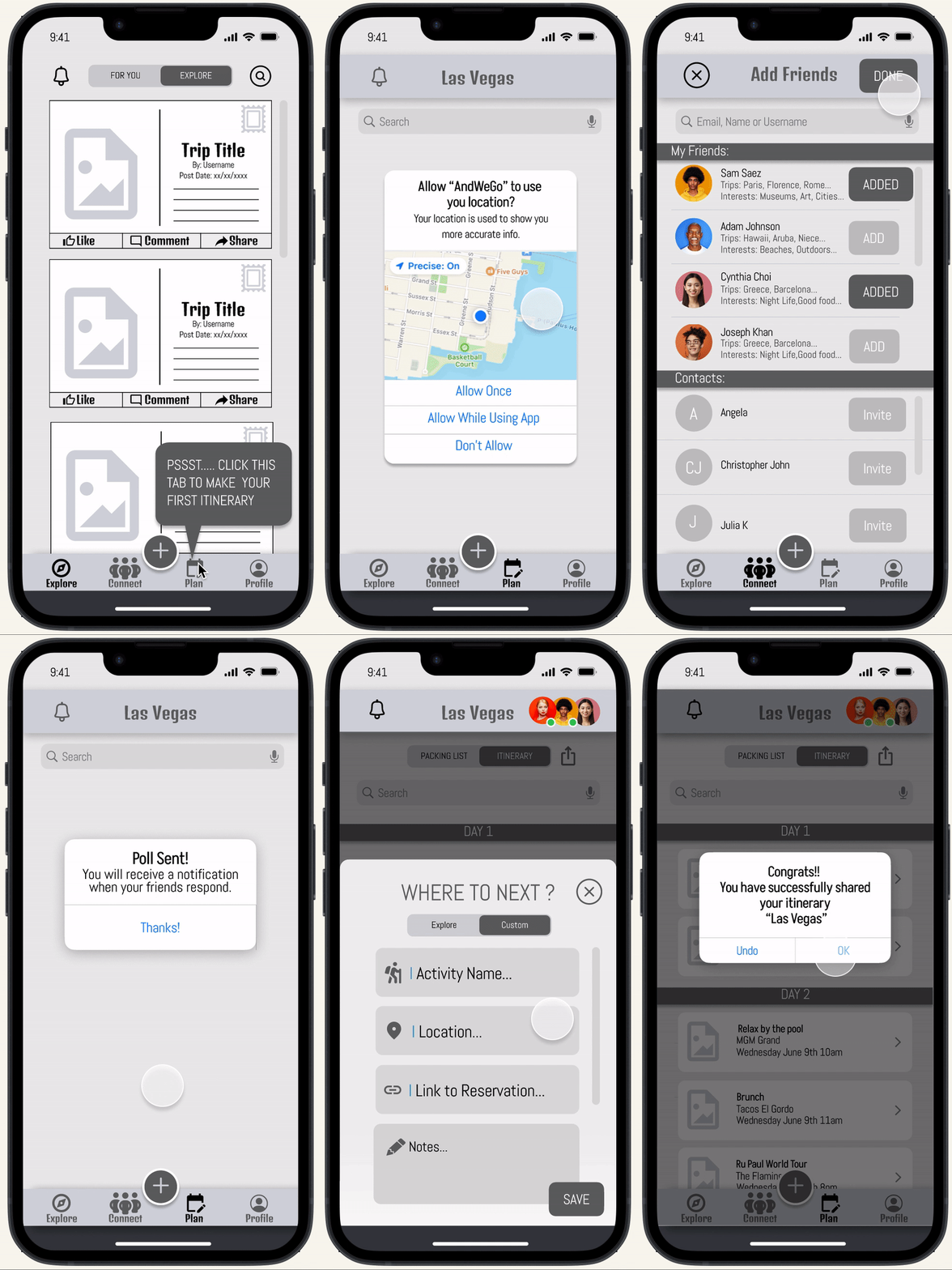
Step #1: Create an Itinerary

Step #2: Add Friends

Step #3: Poll Friends

Step #4: Add Activities

Step #5: Share

Testing
User Testing Plan
Methodology:
I will conduct 4-5 user tests . Each user test will be approximately 10-15 minutes long. After completing the user tests I will analyze the results and prioritize feedback to determine what to iterate.
Scenario:
You are planning a trip to Vegas with your friends Sam and Cynthia!! You want to find out when they would like to go and start making a trip Itinerary. Once your itinerary is complete you want to share with friends and family to see if anyone else has suggestions.
Goals/Objectives:
-
To see if the user flow makes sense & is intuitive to the user.
-
Can the user easily navigate through the app.
-
Is the user interested/engaged in their experience.
Tasks:
-
Create an itinerary
-
Send a poll
-
Add an activity
-
Share itinerary
Success Criteria:
-
Itinerary is made & complete with activity
-
Friend Poll is sent
-
Itinerary is posted
Testing Reflection
Overall my user tests were very successful. I was able to discover some potential usability issues and make minor tweaks to make the app even more intuitive.
Key Findings:
-
A lot of users were for looking for confirmation that they completed the "send poll" task. I added a confirmation page to make it clear to the user that they were successful in completing the task.
-
Need to make confirmation dialogue bigger, more obvious
-
Add like/comment button to post
-
People wanted to add their stay or flight before thinking about an activity - adjust prototype so those areas are clickable and doesn't cause confusion
Final Thoughts:
Allthough this project was limited by time constraints, it was successful in understanding the pain points of travel planning and coming up with a unique solution that could help users with many of their challenges.
I think it could have been beneficial to slow down a bit and spend even more time in the research process, collecting more data both qualitative and quantitative. I found myself constantly referring back to my research when making decisions on the uses flow and design. I can only imagine what I could have achieved with even more information.
What's next...
Further test and iterate on a high fidelity design to gain insight into usability and delight.